Cold pool water cuts swim sessions short. If you’ve looked into solutions, you’ve probably come across both solar covers and solar pool heaters, and wondered which one actually makes sense for your situation. They both involve the sun and your pool, but that’s where the similarities end.
We’ve been designing and installing solar pool heating systems since 1991, serving over 30,000 customers across Southern California, Northern California, and Las Vegas. We’ve had this conversation with thousands of homeowners. Here’s what you need to know.
A solar cover floats on your pool and acts like a lid. It traps whatever heat is already in the water and slows evaporation, which is the main way pools lose warmth overnight. It’s insulation. Useful, but passive.
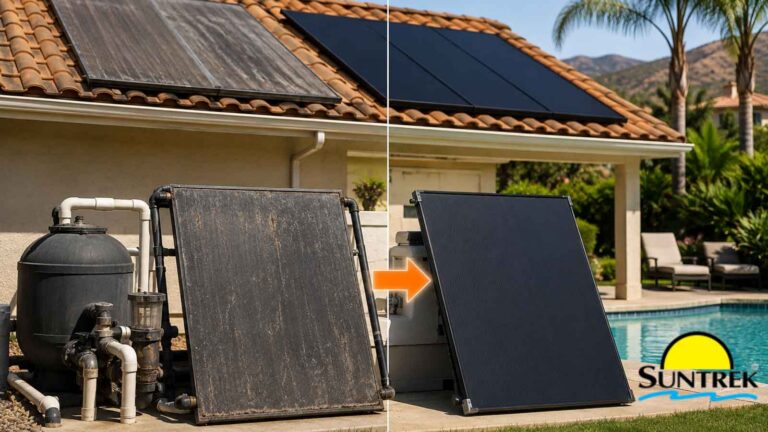
A solar pool heater does something different. It pushes your pool water through collectors on your roof, where it absorbs heat directly from the sun, then returns it to your pool warmer than it left. That cycle repeats all day, every day the sun is out. You’re not just holding onto heat, you’re creating it.
That’s the distinction that matters most. A cover protects what you have. A heater gives you more.
Read More: Solar Pool Heating Panel Performance: What the Ratings Really Mean (and What Really Matters)
Covers work. They reduce evaporation, keep debris out, and help your pool hold onto warmth when the air cools down at night. If you live somewhere with consistently warm weather and only swim on weekends, a cover might be all you need to keep things comfortable.
But covers have limits. They don’t raise water temperature on their own, they just slow down how fast it drops. On overcast days, during cooler months, or if you want to swim in the morning before the sun has had time to warm things up, a cover won’t get you there. It’s a retention tool, not a heating system.
Your pool already has a pump that circulates water through your filter. A solar pool heater ties into that same system and routes water up to collectors on your roof before sending it back to the pool.
Inside those collectors, water flows through channels designed to absorb as much solar energy as possible. By the time it returns to your pool, it’s noticeably warmer. Repeat that process for several hours on a sunny day, and your pool temperature climbs steadily.
The system runs itself. A differential thermostat monitors the temperature at the collectors and in your pool, when there’s heat to be gained, the system circulates. When there isn’t, it doesn’t. No switches to flip, no daily routine. Your existing pump handles the work, and for most residential pools, a standard 1 HP pump is plenty.
Also Read: Solar Designs for New Construction
Not every roof is the same, and that matters.
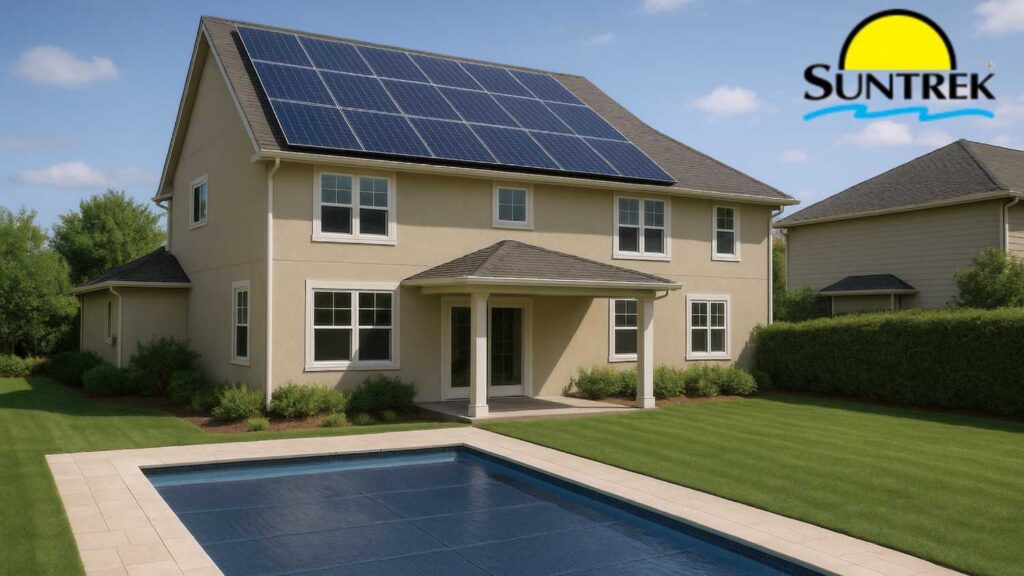
Orientation is the biggest factor. South-facing roofs get the most consistent sun exposure throughout the day, that’s your ideal setup. West-facing roofs work well too, picking up strong afternoon heat. East-facing catches morning sun. Flat roofs can be designed around. North-facing roofs are trickier, but not always ruled out depending on your climate.
Shading is the other consideration. Trees, chimneys, neighboring buildings, anything that blocks sunlight during peak hours reduces how much heat your collectors can produce. We look at this closely during site evaluations.
System sizing comes down to your pool’s surface area. For optimal performance, collector coverage should be somewhere between 80% and 100% of your pool’s surface. Even at 50%, you’ll notice a real difference during swim season, it just won’t be as dramatic.
We walk through all of this during a site evaluation so you know exactly what to expect before anything gets installed.
Forget the products for a second. Think about how you actually use your pool.
Yes! This isn’t an either/or decision for everyone.
A lot of our customers run a solar heater during the day and cover the pool at night. The heater raises the temperature; the cover keeps it from dropping while you sleep. By morning, you’re starting warmer, which means the system reaches your target temperature faster and doesn’t have to work as hard.
If you’re in a climate with big temperature swings between day and night, this combination tends to outperform either option on its own.
If you’re weighing your options and want a clearer picture of what would actually work for your pool, we can help with that.
A solar evaluation covers your roof layout, orientation, shading, pool size, and how your household uses the pool. From there, we design a system that fits, not oversized, not undersized.
We’ve served over 30,000 customers across Southern California, Northern California, and Las Vegas since 1991. If you want to swim more months out of the year without watching your energy bills climb, reach out to us and we’ll walk you through it.