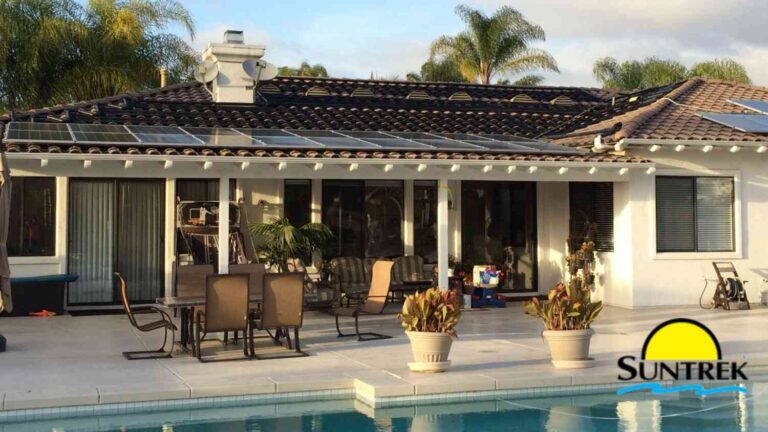
You can maximize your solar pool heating system’s efficiency by optimizing solar collector sizing, flow rate, bypass valve settings, and overnight heat retention. Most systems run below their potential because at least one of these is off. A correctly tuned system keeps your pool between 78°F and 88°F for six to nine months a year, delivering daily gains of 2–8°F above your pool’s unheated baseline.
Most unheated pools in Southern California only naturally reach that comfortable range for one to three months. This guide covers every factor that determines how a solar pool heater works at peak efficiency, what you can adjust yourself, and what a Suntrek Solar service call resolves.
Getting more out of your solar pool heating system does not always mean adding more solar collectors. In most cases, the system you already have is capable of better performance with the right adjustments. These actions address the most common reasons a solar pool heating system underperforms and can be implemented without replacing any equipment.
The single biggest limiter on solar pool heating output is a collector array that is too small for the pool. Optimum coverage ranges from 80–100% of the pool surface area.
A 400-square-foot pool needs between 320 and 400 square feet of collector area to perform at its best. If your system was sized below that threshold, no setting adjustment will close the gap. See solar pool heating sizing and design to confirm your system meets the right ratio for your pool.
A bypass valve left in partial position cuts the flow through the solar collectors and reduces heat output with no visible sign that anything is wrong. The correct setting routes 100% of pump flow through the collectors during solar hours. An automatic solar controller handles this adjustment in real time based on live temperature readings, removing the need for manual intervention entirely
Scheduling your pool pump to run between 10 am and 3 pm maximizes heat transfer per run hour. A pump running overnight produces zero solar pool heating gain and can pull heat out of the water if the bypass valve is not closed. For a breakdown of how pump timing and flow rate affect heat output, see understanding solar thermal pool heating and Delta T.
Flow rate drops, slow leaks at roof penetrations, and scale buildup inside collector tubes all reduce output quietly over time. An annual inspection catches all three before they compound into a bigger efficiency loss.
Suntrek Solar’s solar pool heating service and maintenance program covers the full system checkup in a single scheduled visit. Flow testing, penetration checks, collector flushing, valve calibration, and pump optimization are all included.
The table below covers every variable that affects solar pool heater efficiency. The impact level, what you can check or adjust as an owner, and what Suntrek Solar addresses during a professional service call.
| Efficiency Factor | Impact on Output | Owner Action | Suntrek Solar Service |
| Collector sizing | High | Confirm pool area vs. collector area ratio | Sizing audit, reconfig if undersized |
| Collector orientation | High | Ensure south/west facing, no shading 9am–4pm | Placement assessment and adjustment |
| Flow rate | High | Check pump run schedule, observe flow strength | Flow rate balancing, valve and pump inspection |
| Bypass valve setting | Medium | Use auto valve in heating season, manual off in summer | Valve calibration, auto-valve installation |
| Pool cover use | High | Cover pool overnight and during periods of non-use | Cover recommendation based on pool spec |
| Collector cleanliness | Medium | Clear debris, check for blockages at inlet/outlet | Annual flush and flow test |
| System leaks | High | Inspect connections and roof penetrations annually | Full system inspection and repair |
| Pump efficiency | Medium | Schedule pump during peak solar window | Pump inspection, timer/controller optimization |
Suntrek manufactures two proprietary product lines, the Suntrek Custom and Suntrek ST, engineered specifically for Southern California, Northern California, and Las Vegas climates. The Suntrek Custom uses flexible EPDM elastomer tubing with a patented manifold and turbulent flow channels that maximize heat transfer. Its modular design is built to any size and can conform to roof obstacles such as vents, skylights, hips, and valleys, making it the right fit for complex or space-limited installations. The Suntrek ST uses polypropylene construction in standard 4×8, 4×10, and 4×12 collector sizes, with a modular single-tube design suited for straightforward roof layouts where a direct installation is possible.
Both are designed for maximum heat output across the solar pool heating collectors, flow rate, and orientation factors covered in the table above.
Correct solar collector placement at installation determines the upper limit of what the system can ever achieve. A well-maintained system on a poorly oriented roof section will always underperform a correctly placed one. If your system was installed more than five years ago, a placement review is worth scheduling, as shading conditions and even roofline structures change over time.
South-facing roof surfaces produce the highest annual output for solar pool collectors in California and Nevada. Not every orientation performs equally, and placement directly affects how much work your system can do:
For how California’s current energy code defines acceptable solar pool heating system placement and coverage requirements, see California Title 24 2026 pool heating requirements.
The optimal roof pitch for solar collectors in Southern California is 18–45 degrees. Flatter roofs (under 18 degrees) collect debris more readily and drain less efficiently, reducing long-term performance. Steeper pitches (over 45 degrees) reduce the effective collection window during early morning and late afternoon.
Roof pitch is fixed at installation. If the original installation placed collectors on a suboptimal pitch when a better surface was available, a rerouting assessment is worth pursuing.
The attachment method connecting solar collectors to the roof surface affects both structural integrity and long-term leak risk. Poorly sealed roof penetrations at supply and return lines are a source of slow water loss that reduces system pressure and flow rate over time, and roof damage that goes undetected until it becomes a structural issue. See roof attachment methods for solar pool heating installations for how we minimize penetration points and seals every one correctly
Solar pool heating systems from Suntrek Solar are designed for a 20 to 30 year service life, but reaching that lifespan at full output requires routine attention to the components that take the most wear.
Suntrek Solar has installed and serviced over 30,000 systems across California and Nevada, and the tasks below are what our technicians perform to keep systems running at peak efficiency year after year. For a full picture of what long-term ownership looks like, see the lifespan of a solar pool heater.
Most solar pool heating performance problems are not caused by failed solar collectors. They are caused by issues that reduce water flow through the system.
Our technicians diagnose and correct the most common culprits: automation settings that have been switched off, solar controller programming that resets after a power outage, variable speed pump settings running at the wrong speed for the solar heating circuit, and dirty filters restricting overall system flow. All four are quick to diagnose and fix on a single service visit.
At some point in the 10–20 year life of any solar pool heating system, a leak will occur at a connection point, fitting, or valve. This is normal for any system carrying water under pressure through years of temperature swings and UV exposure. Suntrek treats these as routine repairs, not system failures.
Technicians inspect every connection point along the ground-level plumbing, identify the source, and complete the repair to the same standard as the original installation. The work is straightforward, and most leaks at fittings and valves are resolved in a single service call.
The components between the solar collectors and the pool are where most real service needs occur. Sensors, o-rings, hose connectors, and valves typically need attention every three to seven years.
Automation systems and controllers may need adjustments or upgrades after five to ten years as technology updates and settings drift. Our specialists inspect, adjust, and replace these components, keeping the system’s control logic accurate and its mechanical components in working order.
Every solar pool heating installation involves roof penetrations at the supply and return lines. UV exposure and seasonal expansion and contraction of roofing materials gradually wear the seals at these points. We assess all penetrations during service visits and reseal them before a slow leak develops into a pressure or flow problem.
For flat roofs, we can install ballasted systems that require no penetrations at all, eliminating this maintenance item. Maintenance needs vary depending on pool type and depth. Our blog “Do solar heaters work for in-ground pools” covers what in-ground pool owners should plan for over time
Solar pool heating systems are built to outlast the roof beneath them. Our solar collector removal and reinstallation service covers the full process: collectors come down before roofing work begins, and go back up after, with every connection and penetration sealed to the original installation standard.
Suntrek Solar has designed and serviced solar pool heating systems across California and Nevada for over 30 years. Contact Suntrek Solar today to schedule a visit or a sizing review to confirm your solar collectors are working at their full potential.
Common questions about solar pool heater efficiency and optimization.
Why is my solar pool heater not heating the pool enough?
The four most common causes are: undersized solar collectors relative to the pool surface area, incorrect flow rate through the collectors, a bypass valve not fully routing water through the system, or a pool without a cover losing heat overnight faster than the system can recover during daylight hours.
What temperature can a solar pool heater reach?
A correctly sized solar pool heating system in Southern California can maintain pool temperatures of 78–85°F through the spring, summer, and fall swimming season, and 68–75°F through winter months.
A solar pool heater raises pool temperature by 10–15°F above what it would be without heating. The actual temperature range depends on collector sizing, pool cover use, and ambient nighttime temperatures. See year-round swimming in SoCal for seasonal temperature expectations by region.
Does a pool cover really make that much difference to solar heating efficiency?
Yes, and it is the only efficiency improvement that requires no service call, no equipment, and no settings change. A pool that consistently loses 6–8°F overnight without a cover requires the solar collectors to replace that heat every morning before the pool reaches a comfortable temperature. With a solar blanket in place, the system spends far less of its daily run time recovering lost heat and more of it maintaining or raising the target temperature.
How often does a solar pool heater need maintenance?
An annual inspection and flow test is the minimum for a solar pool heating system to maintain peak efficiency and its full service life. Collector flushing is recommended every two to three years in hard water areas.
Roof penetration seals should be inspected annually and replaced every five to eight years. Suntrek Solar’s solar pool heating service and maintenance program covers all of these on a scheduled basis.
What is the best time of day to run a solar pool heater pump?
10am to 3pm is the peak solar window for solar pool heating in California and Nevada. Beyond timing, pump speed matters — if you have a variable-speed pump, running it at a lower RPM during solar hours increases the temperature rise per pass through the collectors. An automatic solar controller removes the need to manage either timing or valve position manually by switching based on live temperature differentials between the collector surface and the pool water.
How long does a solar pool heater last?
Solar pool collectors manufactured by Suntrek Solar carry a 10-15-year warranty and are designed for a 20+ year service life. The actual lifespan depends on installation quality, UV exposure, water chemistry, and whether annual maintenance is performed. Systems that are correctly installed, annually inspected, and operated with proper water chemistry consistently reach the upper end of that range.
Can I upgrade my existing solar pool heater to improve efficiency?
Yes. The most common efficiency upgrades for existing solar pool heating systems are: adding an automatic solar controller to replace manual valve management, expanding the collector array if the current system is undersized for the pool, upgrading the pump to a variable-speed unit for better flow control, and adding a pool cover. We asses existing systems against current sizing standards and recommend targeted upgrades rather than full replacement unless the system is at end of life.