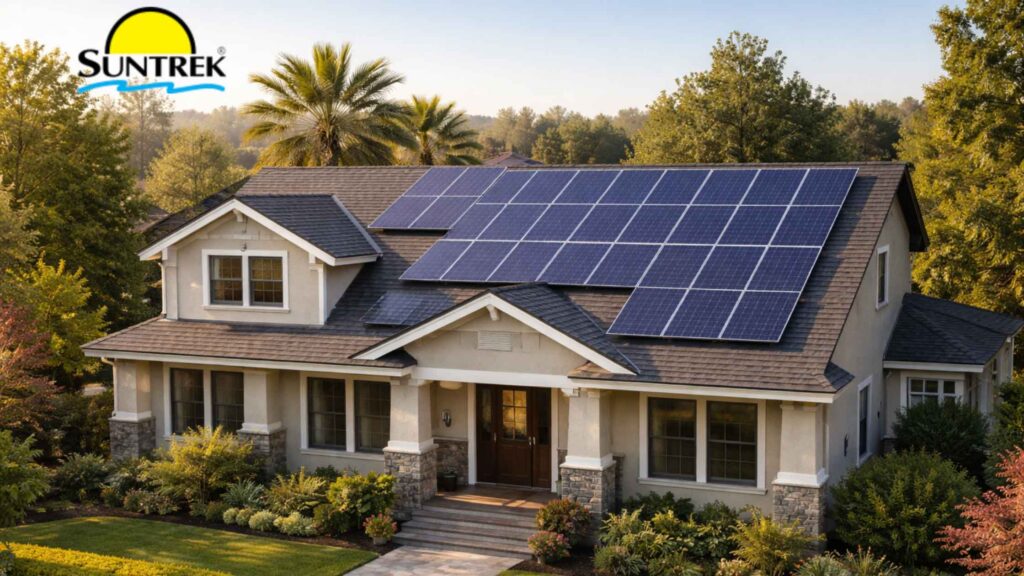
The number of solar panels for home installations varies based on several factors specific to each property. Two houses on the same street can require completely different system sizes, and both estimates can still be correct.
This blog is for homeowners who are evaluating solar for the first time or comparing estimates that don’t seem consistent. If you want to understand the logic behind system sizing before you talk to an installer, this is where to start.
Three primary factors determine the size of a solar panel installation for a home. These inputs allow solar professionals to calculate the system capacity required to offset your electricity usage.
Your electricity usage, measured in kilowatt-hours (kWh), sets the production target for your solar system. You can find your annual kWh on your utility bills, and most providers show a 12-month usage history. Homes that use more electricity require larger systems, which usually means installing more solar panels.
Solar panels are rated by how many watts they produce under standard test conditions. Residential panels commonly range from 350W to 450W. Higher-wattage panels generate more electricity per panel, so fewer panels may be needed to reach the same system capacity.
Peak sunlight hours measure how much usable solar energy your location receives each day. Areas with stronger sunlight allow each panel to generate more electricity over the year. Because of this, homes in sunnier regions may need fewer panels than similar homes in locations with lower solar exposure.
Once you know your energy usage and local sunlight conditions, estimating the number of solar panels your home may need becomes relatively straightforward. Solar system sizing is essentially a calculation of how much electricity your home uses and how much energy each panel can generate under typical conditions in your area.
A simplified formula used in preliminary estimates looks like this:
Monthly electricity usage (kWh) ÷ monthly peak sun hours ÷ panel wattage (in kW) = estimated number of panels
To see how this works in practice, consider a typical household example.
Using the formula:
900 ÷ 165 ÷ 0.4 ≈ 14 panels
This calculation provides a baseline estimate of the number of panels required to generate enough electricity to offset monthly usage.
However, real solar system design goes beyond this simplified calculation. Installers account for factors such as inverter efficiency, wiring losses, and temperature-related performance reductions. These adjustments typically increase the system size by about 10 to 25 percent to ensure the system produces enough electricity under real operating conditions.
For that reason, professional system designs often recommend slightly more panels than the basic formula suggests, ensuring reliable energy production throughout the year.
Not all solar collectors are rated the same way, and knowing how to read those numbers makes a meaningful difference when comparing options, see Solar Pool Heating Panel Performance: What the Ratings Really Mean (and What Really Matters) for a full breakdown.
The sizing formula assumes the panels can actually be installed where they need to go. There are factors that determine whether a given system design is physically achievable, and how well it will perform once installed.
The number of panels your roof can support depends as much on how they are attached as on the available surface area, Roof Attachment Methods for Solar Installations covers how mounting method, roof type, and structural load factor into every Suntrek installation.
Solar system sizing is not a situation where bigger automatically means better. The size of the system should match the load it is designed to serve, and there are real consequences on both ends of the spectrum.
Every panel added beyond what your home consumes increases upfront cost without proportionally increasing savings. Utility interconnection agreements in California and Nevada cap how much excess energy can be fed back to the grid. Generation beyond that cap produces no financial return, which means an oversized system may never recover its full cost.
A system that does not cover your consumption leaves you dependent on the grid for the remaining load and at full retail rates. If energy demand grows after installation, the gap between generation and consumption widens. The gap between what you generate and what you use determines your ongoing utility bill.
A properly sized system designed around your actual usage, roof capacity, and local utility structure delivers the strongest long-term return. It maximizes offset within the physical and regulatory constraints of your property, minimizes the payback period, and performs predictably over the system’s lifetime.
Suntrek Solar has been designing, manufacturing, and installing solar systems since 1991, serving over 30,000 customers across California and Nevada. As a licensed solar contractor and equipment manufacturer, we handle the full process in-house, from site assessment and system design through installation and ongoing service.
Every home has different energy usage patterns, roof conditions, and solar potential. Because of this, a reliable solar system design requires more than a simple online calculator. We follow a structured process to ensure each solar installation is properly sized for the homeowner’s energy needs and property conditions.
The process typically includes:
At Suntrek Solar, every estimate starts with a free, no-obligation site assessment. Schedule your free estimate or call (949) 348-9276.
No. Panels are placed on roof faces that receive the most direct sunlight, typically south, southwest, or west-facing surfaces in California. East-facing panels can supplement production but are not always necessary. Suntrek’s roof assessment identifies the most productive placement for your specific roof layout.
Yes, in most cases. Suntrek designs systems with future expansion in mind, particularly for homeowners anticipating added loads like an EV charger or battery storage. Expandability depends on remaining roof space, inverter capacity, and utility interconnection limits, all of which are assessed during the initial design process.
Shading reduces the energy output of affected panels, which means a shaded system may require additional panels to meet the same production target as an unshaded one. The impact depends on the degree of shading, the time of day it occurs, and the inverter technology used. Suntrek accounts for shading conditions during the site assessment to ensure production estimates are accurate.
Yes. Suntrek designs and installs solar battery storage systems alongside PV installations for homeowners who want backup capability, peak-rate protection, or greater energy independence. Battery sizing is determined by the same consumption analysis used to size the solar system.