A battery stores that energy and discharges it during the 4 pm–9 pm peak window when the grid charges $0.40–$0.70+ per kWh. That arbitrage is where the value is. Suntrek Solar installs PV solar and battery storage systems for homeowners across California and Nevada.
California’s NEM 3.0 dramatically changed the math for solar owners — and made battery storage the smarter play.
For the full history of how California utility billing has shifted the solar equation, see California utilities vs. solar.
Not every homeowner benefits equally. The table below maps the most common profiles to an honest verdict.
| Homeowner Profile | Key Reason | Battery Storage Worth It? |
| NEM 3.0 customer with solar | Exports earn only $0.05–$0.08/kWh; battery captures that value | Yes — strong financial case |
| High electricity bill ($200+/mo) | Large load to offset; peak-rate savings significant | Yes — faster payback |
| Wildfire/outage-prone area | Backup power during PSPS events has direct practical value | Yes — beyond bill savings |
| NEM 2.0 grandfathered customer | Still earns near-retail export credits until 20-year mark | Maybe — run the numbers first |
| Low electricity user (<$100/mo) | Smaller load means smaller savings; payback extends | Depends on backup priorities |
| EV owner | Charge EV from stored solar; avoids peak-rate grid charging | Yes — high self-consumption value |
| Existing solar, no battery | Pre-NEM 3.0 system approaching 20-year grandfathering end | Yes — plan upgrade now |
The strongest case is a NEM 3.0 customer with a high bill, an EV, or a home in a wildfire PSPS zone. For sizing your system to your actual usage profile, see solar battery storage sizing and design.
Looking at your electric bill can feel confusing, especially when energy use changes throughout the day. Knowing how solar battery storage fits into that picture can help make those changes easier to understand.
Your solar panels produce peak energy between 10 am and 3 pm. Your household uses the most energy between 4 pm and 9 pm. A 10 kWh battery system shifting 3,500 kWh per year saves approximately $1,400 annually from load shifting alone. For real-world performance data, see solar battery storage performance.
California’s Public Safety Power Shutoffs, heat-wave overloads, and aging grid infrastructure have made multi-day outages a real scenario for many homeowners.
A battery system switches to backup power within milliseconds during an outage.
Paired with solar, it continues charging from the sun each day the outage persists, keeping critical loads running indefinitely in California’s climate.
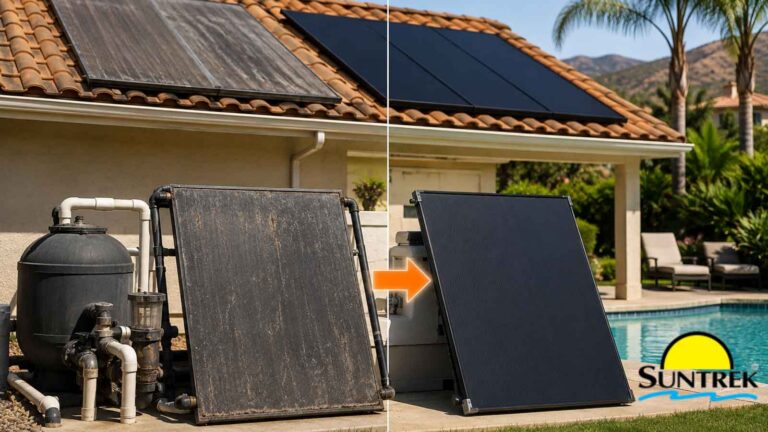
Suntrek Solar also services solar pool heating alongside battery storage, so homeowners can maximize energy independence across multiple systems.
A correctly sized solar-plus-storage system covers 60–80% of total household electricity use.
The remaining 20–40% is purchased during off-peak hours at lower rates, further reducing the annual utility bill.
For how solar pool heating and battery storage can increase your home’s resale value together, see will a solar pool heater increase property value in California.
Costs can add up quickly, which is why available incentives still matter. There are still options in 2026 that can help lower overall expenses and make the setup more manageable.
California’s SGIP provides approximately $150 per kWh of battery storage capacity for general-market residential customers.
That covers roughly 15% of a typical battery installation cost.
Income-qualified households and those in high fire-threat zones qualify for substantially higher rebates. Suntrek Solar advises every client on current SGIP eligibility as part of the proposal process.
The 30% federal ITC for purchased residential solar and battery systems expired December 31, 2025, under the One Big Beautiful Bill.
For 2026 direct-purchase installations, the residential ITC is no longer available.
Battery systems installed through a lease or PPA may still benefit from the Section 48E commercial credit through end of 2027, typically reflected in reduced monthly costs.
For the full environmental and financial case for going solar in California, see the eco-friendly benefits of solar pool heating in California.
Solar battery storage systems installed as part of a qualifying solar project are excluded from property tax reassessment.
The added home value from the system carries no additional property tax burden, currently in effect through the 2026–2027 assessment year.
For how solar installations affect Orange County home values, see the impact of solar pool heating on Orange County home resale value.
Homeowners adding a solar water heater reduce domestic hot water costs on top of battery savings, stacking returns across two systems.
Not every home is the right fit for battery storage, and Suntrek Solar will always tell you when it isn’t. Here are the profiles where the financial case is weaker.
If any of these situations sound familiar, that’s not a reason to rule out storage entirely. It’s a reason to get the numbers reviewed properly. For installed cost ranges, see solar battery storage pricing.
Suntrek Solar sizes every system to historical usage data and stated backup goals. For installed cost ranges before you reach out, see solar battery storage pricing.
Suntrek Solar has designed and installed solar battery storage systems for homeowners, businesses, and government facilities throughout California and Nevada. Contact us today for a free site assessment that includes a usage analysis, current incentive eligibility, and a payback estimate based on your actual utility bill.
Common questions about solar battery storage value and timing in 2026.
Yes, for most new solar customers under NEM 3.0. Low export credits and high peak-rate grid electricity make storing and self-consuming solar energy significantly more valuable than exporting it.
A 10 kWh battery discharging daily under NEM 3.0 can save approximately $1,200–$1,800 per year through load shifting at current California peak rates. SDG&E territory, with the highest retail rates in the state, typically sees the strongest savings.
In most cases, yes. AC-coupled batteries can be added to most existing solar systems regardless of inverter brand or age. Suntrek Solar assesses compatibility as part of every consultation.
The 30% residential ITC for purchased systems expired December 31, 2025. Battery systems installed through a lease or PPA may still benefit from the Section 48E commercial credit through end of 2027.
Most residential solar batteries carry 10-year warranties and are designed for a 15–20 year functional lifespan. Lithium iron phosphate (LFP) batteries generally hold up better under California’s daily charge/discharge cycle.