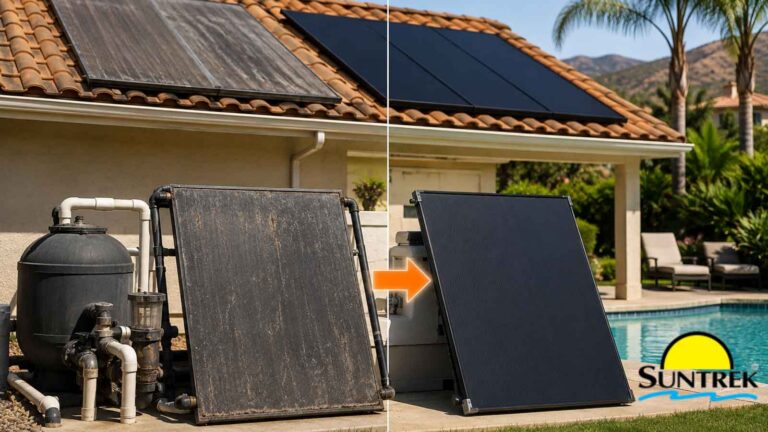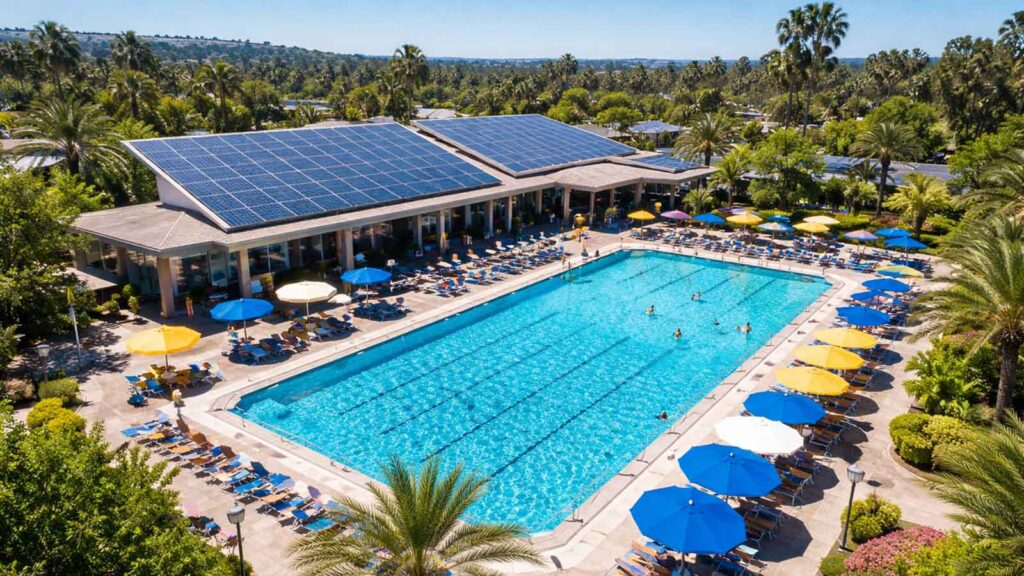
Thinking about solar pool heating for your existing pool? It’s a system that uses rooftop or ground-mounted solar collector panels to warm your water with the sun’s thermal energy. Adding it to an existing pool involves a site evaluation, system sizing, panel selection, plumbing integration, and professional installation to ensure optimal performance. For full heating efficiency, solar collector coverage should equal 80–100% of your pool’s surface area.
Suntrek installs two types of panels: Suntrek ST for standard setups and Suntrek Custom (flexible EPDM rubber) for more complex roof layouts. Pool owners unfamiliar with the technology can review how solar pool heating works before evaluating their setup. Once installed, the system can raise your pool temperature by 10–15°F, keeping your water warm for 6–9 months, with costs depending on factors like pool size and panel type.
After installation, several measurable improvements happen in how your pool performs, how long you can swim, and how much it costs to operate. System output depends on collector area and sun exposure. View solar pool heating performance data for projected results.
Explore the effect of temperature differences on your pool in our solar thermal pool heating and Delta T blog
Installing solar heating involves a sequence of steps that are crucial to achieving safe, efficient, and durable results. Our solar company manages each stage, ensuring everything is done correctly the first time. Here’s what you can expect:
Before installation begins, the system must be evaluated to confirm your pool can support solar heating. Suntrek’s team evaluates roof space, pool surface area, and pump capacity during the solar pool heating sizing and design process. This includes reviewing pool surface area, circulation rate, pump capacity, and available space for collectors. Proper sizing is critical: for full performance, solar collectors should cover 80–100% of your pool’s surface area. Systems sized at around 50% coverage can still provide noticeable heating, though with reduced performance.
Full guidance on sizing your solar heating system is available on the how to size a solar heater for your pool]page.
During this assessment, installers also check for factors that may require upgrades or adjustments. These can include insufficient pump capacity, heavily shaded roofs, or incompatible plumbing diameter. Most residential pools already have adequate equipment. In many cases, a 1-HP pump is sufficient for standard installations, but confirming compatibility ensures the system operates efficiently and avoids unnecessary strain on existing components. New pool construction and major renovations must now comply with California Title 24 2026 pool heating requirements.
Suntrek installs two main collector types designed for different roof layouts and installation conditions. Full specifications for both panels are available on the Suntrek solar pool heating products page.
| Spec | Suntrek Custom (EPDM) | Suntrek ST (Polypropylene) |
| Material | EPDM rubber (flexible) | UV-stabilized polypropylene (rigid) |
| Available Sizes | Custom lengths up to 50 ft | 4×8 ft, 4×10 ft, 4×12 ft |
| Mounting | Adhesive + straps (low profile) | Gator Clamps (snap-on install) |
| Max Operating Pressure | 40 psi | 90 psi |
| Weight (empty) | 1 lb/sq ft | ~0.35 lb/sq ft |
| Roof Penetrations | Fewer (adhesive-based) | Fewer (clamp-based) |
| Warranty | 15 years | 10 years |
| Best For | Complex roofs with vents, skylights, corners | Standard rectangular roofs |
| Certification | FSEC #92012, NSF/ANSI 50 | SRCC certified |
Installed system costs depend on pool size and panel type. See current solar pool heating pricing for estimates. Homeowners comparing gas, electric, and solar options can review the best heating solution for your pool.
Once the collector type is selected, installers design the layout to maximize solar exposure and maintain proper hydraulic flow. Panels are typically installed on south- or west-facing roof sections, though ground mounts or rack systems can be used when roof placement isn’t suitable.
Standard installations use Schedule 40 PVC piping, with pipe diameter matched to system flow rate:
Routing is planned to maintain balanced water flow across all collectors, with valves and bypass controls placed according to Suntrek specifications.
Installation involves mounting the collectors, connecting plumbing lines, and integrating the system with your pool’s filtration equipment. Panels are secured according to their design — Suntrek Custom collectors are attached with adhesive and straps, while Suntrek ST panels use Gator Clamp mounting hardware for secure positioning.
After installation, the plumbing system is pressure-tested, valves are calibrated, and drainage is verified to ensure proper operation when the pump shuts off. A typical residential solar pool heating installation usually takes about 1–2 days, depending on roof layout, system size, and plumbing complexity.
Solar pool heating systems are designed for long-term reliability, but regular maintenance helps ensure consistent performance and protects the collectors and plumbing components. Most upkeep involves simple periodic checks combined with a yearly professional inspection.
From annual inspections and system diagnostics to performance checks and preventative care, our technicians ensure your collectors, plumbing, and valves continue working efficiently. Suntrek provides ongoing solar pool heating service and maintenance for installed systems.
How much does it cost to add solar heating to an existing pool?
Costs vary depending on your pool size, panel type, and roof configuration. Contact Suntrek for a site-specific quote based on your pool and roof layout to get an accurate estimate.
How long does solar pool heater installation take?
Most residential installations are completed in 1–2 days with minimal disruption to pool use. Complex roof layouts may require slightly more time depending on system size.
How warm can a solar-heated pool get?
Solar heating typically raises water temperature by 10–15°F above ambient. Actual gains vary with collector coverage, sun exposure, and season. Learn more at How Warm Can a Solar-Heated Pool Get?.
What size solar heater do I need for my pool?
Collector coverage should equal 80–100% of your pool’s surface for full heating performance. Even systems sized at 50% coverage provide noticeable temperature gains. More details at How Big of a Solar Heater Do I Need?.
Do I need a new pump for solar pool heating?
Most existing pool pumps are sufficient. A standard 1 HP pump handles typical residential installations, though longer pipe runs or higher roofs may require higher-capacity pumps.
What is the difference between Suntrek Custom and Suntrek ST panels?
Suntrek Custom panels use flexible EPDM rubber, ideal for complex roofs with vents, skylights, or corners. Suntrek ST panels are rigid polypropylene, best for standard rectangular roofs and faster installs. See the comparison table above for detailed specs.
Does solar pool heating work in winter?
Yes, solar heating operates year-round in Southern California. Performance may drop in overcast or cold conditions, and the system includes automatic drain-down to prevent freeze damage.
Talk to our team today to schedule a checkup or learn how to keep your system running efficiently year-round.